
MTO therapist hub
Everything you need to work with My Therapist Online
Forms · Referrals · Payments · Private Practice Support · Resources · MTO Benefits

Things you'll use regularly
⭐ Bookmark this page — this is your MTO home for forms, processes, resources and support.
What's Inside Your MTO Therapist Hub?

⭐ Tip: Bookmark this page! It's your go-to place for MTO information, useful forms and ongoing support.
Everything you need to work confidently with MTO, support your private practice and make the most of your referrals.
● Working with MTO – How our service works and the benefits of joining our network.
● Quick Links & Forms – Update availability, submit session dates and client feedback.
● New Therapist Registration – Getting set up, required documents and your therapist profile.
● Referrals & Client Introductions – From receiving a match to the free introductory call and starting therapy.
● Payments & Invoicing – Session fees, our service charge, client payments and therapist payouts.
● Clinical Essentials – Professional responsibilities, safeguarding, confidentiality and good practice.
● Grow Your Referrals – Practical ways to improve your profile and attract more suitable clients.
● Supervision & Peer Support – Connect with experienced supervisors and fellow therapists.
● Therapist Benefits & Discounts – Exclusive offers on training, professional resources and services.
● Meet the MTO Team – Who we are and how to get help when you need it.
Why Therapists Choose MTO
More of the right clients. Less admin. Greater flexibility.
At My Therapist Online, we believe you should be able to focus on what you do best — helping your clients.

As a therapist-led service, we understand the demands of private practice. That's why we work hard behind the scenes to bring you suitable referrals, reduce your administrative workload and support you in building a sustainable caseload that works for you.
The benefits of working with MTO
✅ Personally matched client referrals – Our clinical team carefully reviews every application, matching clients to your expertise, experience and availability.
✅ No joining or subscription fees – It's completely free to join our therapist network, with our service fee applying only when chargeable therapy sessions take place.
✅ You set your own fees – Remain in control of your session rate, with transparent service-fee arrangements.
✅ Complete flexibility – Choose your working hours, availability and how many MTO clients you'd like to see. No minimum commitments.
✅ We invest in finding clients – Through SEO, advertising, partnerships and ongoing promotion, we work to attract new clients seeking therapy.
✅ Less financial administration – We manage client invoicing, payment collection and follow-ups, so you don't have to chase payments.
✅ Your own professional therapist profile – We showcase your experience, qualifications and specialisms to help potential clients understand your expertise.
✅ A real team behind the service – Our approachable, therapist-led team is here to help with referrals, questions and the practicalities of working with MTO.
✅ Exclusive therapist benefits – Access discounts on selected clinical resources, training and professional services through our partnerships.
✅ Grow at your own pace – Whether you're building a private practice or simply have a few appointments available, we work around your capacity.
A partnership that works around you
We're here to complement your independent practice, not take it over. You remain in control of your clinical work, while we take care of much of the work involved in finding, matching and managing client referrals.
No pressure. No minimum hours. Your fees, your availability. Thoughtful matching and practical support from MTO.
Want to hear what it's like working with us? Read feedback from therapists already part of the MTO network below.
How Referrals Work – What You Can Expect from MTO
We work hard to put you in front of the right clients. The final choice always belongs to the client.
At MTO, every client application is personally reviewed by our clinically trained matching team.
When a client's needs align with your clinical expertise, experience, session fee and availability, we'll actively consider you and recommend your profile wherever we believe you're a strong match.
What you can expect from us
Active, personal matching – We regularly consider your profile for suitable client applications.
Recommendations that reflect your expertise – We highlight why we believe you could be a good therapist for each client.
Complete flexibility – You choose your own session fees, availability and how many clients you can accommodate.
Ongoing support – We're happy to help you strengthen your profile and improve your chances of being selected.
What we can't guarantee
We usually recommend a small selection of suitable therapists to each client, explaining why we feel each could be a good match.
Ultimately, the client decides who they would like to work with.
This means that even when we strongly recommend you, we cannot guarantee that the client will choose to make contact or begin therapy.
For this reason, we cannot promise a particular number of referrals or new clients.
Not receiving many referrals? Let's work on that together!
There may be simple changes that could help your profile stand out and make you suitable for more client applications.
With over a decade of experience matching clients and therapists, we've learned a great deal about what helps clients feel confident when choosing a therapist.
A few things we can review together
Your session fee – Is your fee competitive compared with therapists offering similar experience and expertise? Does it fall within the budgets clients are looking for?
Your availability – Could offering a wider range of appointment times help you reach more clients? Evening appointments are particularly popular, so offering these where possible may increase your opportunities.
Your specialist areas – Does your profile clearly highlight your strongest clinical skills and experience? Listing too many specialisms can sometimes make it harder for clients to recognise where your particular expertise lies.
Your therapist profile – Does it feel warm, approachable and personal? Can clients easily understand your therapeutic approach, who you work best with and what they can expect from therapy with you?
Testimonials and introduction videos – Do you have recent client testimonials that you have permission to share? These can be incredibly reassuring to someone choosing a therapist. If you have an introduction video, watch it back or ask someone you trust for feedback. Does it feel natural, welcoming and help clients get a sense of what working with you might be like
Head to the 'Grow Your Referrals' section below for more practical tips and ideas.
We're working towards the same goal
It's completely FREE to join and be listed with MTO.
There are no subscription fees, minimum hours or guaranteed commitments. We only receive our service fee when successful referrals progress to chargeable therapy sessions.
So it's very much in everyone's interest to help your profile attract the right clients!
If referrals are quieter than you'd hoped, please get in touch. It doesn't necessarily mean your profile isn't being recommended. There may simply be a few adjustments we can make together to give you a better chance of being chosen.
We're here to support your independent practice and will always do our best to help you make the most of being part of MTO.
New to MTO? Start Here
Let's get you set up for success
Great therapist matches start with really knowing our therapists.
At My Therapist Online, we take pride in the fact that every therapist recommendation is personally considered by our clinically trained team. We don't simply give clients a directory to search through — we take the time to understand their individual needs and carefully match them with therapists who have the right skills, experience and approach.
That's why we take our therapist registration process seriously.
The more we know about you, your clinical strengths, specialist interests and professional experience, the more confidently we can recommend you to the clients you're best placed to help.
Your registration also gives us the information we need to showcase your expertise and promote you effectively. When we recommend you to a prospective client, we want to be able to explain not just what you offer, but why we believe you're such a good match for them.
We appreciate that getting set up involves completing a few forms and gathering documents, but each step has a purpose:
✅ Building trust – Verifying professional credentials, insurance and references helps us maintain a trusted network of qualified therapists.
✅ Making better matches – Understanding your specific skills, experience and preferred areas of work helps us recommend you to the right clients.
✅ Showcasing your expertise – A strong profile, professional photograph and clear description of your approach help clients feel confident about choosing you.
✅ Helping referrals turn into therapy – Accurate availability and a clear understanding of your preferences help us make timely, appropriate recommendations.
Taking a little extra care at the start makes all the difference.
Our aim isn't simply to add you to our therapist network. It's to get to know you well enough to become a confident advocate for your skills, connecting you with clients who are genuinely suited to your expertise.
Let's get started! Below you'll find everything you need to complete your registration and begin receiving MTO referrals.
Therapist Registration
-
Link to the initial registration form is here.
Our team review all registrations. If you are successful we will ask you to send supporting documents and complete the final steps for getting you set-up on our systems and website.
-
Please email scanned or photographed copies.
Professional training certificates to support all your credentials. e.g. BABCP accreditation
Proof of professional body registration including number (BABCP/BPS with HCPC registration (for protected titles) / BACP / UKCP Accreditation.
A current enhanced DBS (Disclosure & Barring Service) certificate.
Current Professional indemnity insurance certificate (minimum coverage £5 million). You will need to send us new copies of this annually.
Photo Identification. Copy of passport or photo driving license, scanned or a clear photo.
Please note - We require therapists to possess a minimum of 3 years of post-qualification clinical experience.
-
1. MTO and DBS Checks:
MTO cannot directly apply for DBS checks on behalf of self-employed or independent therapists.
However, MTO can register with an umbrella body that provides DBS checks to affiliates. This allows MTO to facilitate DBS checks for you, but the cost would be covered by the therapist.
2. How to Get a DBS Check:
Advanced DBS Check: Independent therapists need an advanced DBS check no older than 3 years, especially if working with vulnerable individuals or children.
Applying via an Umbrella Body: You can use services like DBS Check Online or Disclosure Scotland to process your application through a third-party umbrella organisation that specialises in working with independent professionals.
3. BABCP and DBS Checks:
BABCP and BACP do not handle DBS checks directly, but emphasise professional standards.
It's important for therapists working with vulnerable clients to proactively obtain DBS checks to maintain trust and comply with ethical standards.
Summary
Independent therapists affiliated with MTO should independently seek DBS checks through umbrella bodies or third-party services. This builds client trust and is crucial for working with vulnerable populations.
-
The profile wording needs to explain your clinical skills and experience clearly to ensure the client feels confident in their selection of you.
Have a look at other therapists’ profiles on our website as a guide for writing this. We can hep edit the wording to best promote you.
We will also add the details from the skills form to the wording on your profile page.
-
Please use our photo guidelines which are designed to help you create an image that is not only professional but also welcoming, allowing potential clients to feel connected to you even before the first session.
Expression - Capture a head-and-shoulders shot with you directly facing the camera, offering a warm smile or approachable expression that conveys your professional demeanour.
Attire - Dress in your usual professional attire to provide a true-to-life preview of how you will present yourself in therapy sessions.
Recent Image - The photo should be recent, taken within the past three years, to ensure an accurate representation of your current look.
Background - Opt for a simple, uncluttered background. Leave ample space around you in the photo for flexible cropping to fit various dimensions on our website.
Quality - High-resolution images are essential for clarity and detail, contributing to the overall impression of professionalism.
Authenticity - Refrain from using selfies. A photograph taken by another person or a professional service is preferable to maintain quality standards.
For visual reference, please view the six therapist profiles on our homepage. These will serve as a model for the type of photo we find most suitable.
-
Please complete this skills form.
Please note - the details in this form are used by our team to match you with the right clients.
Put a 5 for the problems you feel you are an expert or extremely experienced in treating.
Put a zero in the problem areas you do not wish to work with.
-
Please provide the names and email addresses of two professionals who have worked with you in a clinical setting completing the job you will be providing at MTO. This will have ideally observed you with clients or discussing clients in a professional setting.
-
Regular availability updates - Please keep us as up-to-date as possible by filling out the availability form regularly. Therapist typically update this when they are due to discharge a client soon, as there can be a is a 1-3 week lead time on sending referrals.
Holidays - Please let us know any up-and coming holidays.
-
Your first three months with MTO
Starting with a new service is always a getting-to-know-you process — for you as much as for us. Your first three months are an opportunity for us both to make sure MTO is the right fit for you, and that we're setting you up for a positive experience.
Here's what that looks like in practice:
We'll be looking at how things are going together. Client feedback plays a big part in this — how clients experience the therapeutic relationship, session engagement and any correspondence with you all feeds into the picture. We'll also be checking in ourselves and will always be transparent with you if something needs addressing.
What we ask of you during this time:
Bring your full professional self to every session and all client communication — warmth, clarity and good ethical practice go a long way
Treat the free initial consultation as an important first step in the therapeutic relationship, not just an admin task
Keep us updated on your availability and let us know if anything changes
Reach out if you have any questions or concerns — we'd much rather you ask than struggle on alone
At the end of the three months we'll have a clear picture of how things are working. For most therapists this is simply a formality — a moment to acknowledge that things are going well and continue as normal. If for any reason the fit isn't right on either side, we'll have an honest and respectful conversation about next steps.
We want this to work for you. If at any point during your trial you're unsure about anything, please get in touch — that's what we're here for.
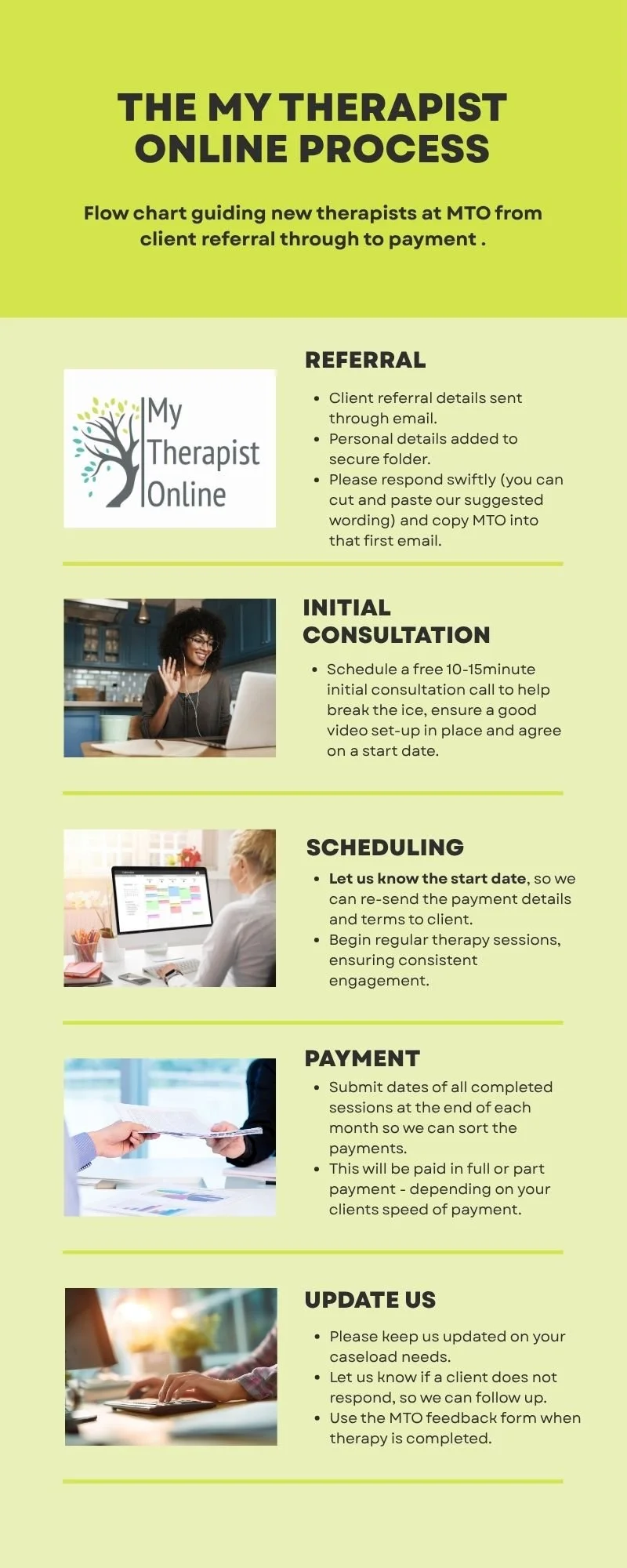
The My Therapist Online Process
-
Once a client has confirmed you as their therapist, we will send an introduction email between you. Links to terms and payment info is included in this email for both your reference.
You will receive a separate email with their problem description and first name initial and surname (e.g.L.Smith) - Please do not use full name on any emails.
A link to their full personal details located in your individual password-protected folder (we will send you the password for this folder separately).
Please follow the introduction email as soon as possible with a friendly hello and suggestions of dates for an initial introduction call, as this helps to break the ice. Remember, most clients are quite nervous about starting therapy, so I’m sure it goes without saying, please keep your wording as warm and professional as possible, first impressions matter.
Please use an MTO header and footer in all emails - as provided. Feel free to edit the specific wording of our suggested intro email.
IMPORTANT THINGS TO NOTE
1 - The quicker we can turn around this initial client match, the more likely they will move into therapy.
2 - Please copy (cc or bcc) us in on your initial responses so we can better track if this moves forward or if we need to follow up with the client.
3 -If you don’t think the client’s problem match’s your skill and experience, please let us know the reasons for this, so we can adjust the details on the skills form to prevent any future mismatches from happening.
If you haven’t heard back within 3–5 days, please let us know straight away. Emails are often missed or end up in junk folders, and we can step in to follow up.
Keep us updated early if communication has stalled. The sooner we know, the sooner we can support both you and the client in reconnecting.
Avoid long gaps (weeks or more) without an update, as this greatly increases the risk of the client disengaging altogether.
-
This step is not compulsory, if the client is keen to start asap, then do so.
The Initial consultation is a free 10-15-minute initial call (Zoom or phone call) where you can help break the ice and agree a start date
Please note - at this early stage engagement is at it highest, but so can anticipation anxiety! The sooner the start date, the more likely they will move into paid therapy.
There are 3 main aims of the 10-15 minute initial meeting:
1 - Your client can meet you & check they are comfortable in proceeding with you as their therapist;
2 - You are able to meet the client and check you are comfortable treating them;
3 - To support the client in taking the next big step to commit to starting therapy with you by confirming a start date.
Please remember - this could be the first time they have spoken to anyone about their problems and you play an important role in helping them start therapy.
There will not be time to dive into their problems at this meeting, but reassure them that is what will be looked at in the first full (paid) for appointment.
We need the start date please - Please let us know the agreed start date so we can re-send a copy of the terms and payment details.
All clients make an initial advanced payment ahead of the first appointment (the main reason that we require the start date to ensure this is in place before then).
After that, all payments are made at the end of the month (unless you prefer to use our automated booking and payment system which is available to therapists who provide over 10 sessions per week with MTO).
-
As independent practitioners within My Therapist Online, our therapists maintain autonomy, practicing according to the high standards of their professional qualifications. We respect your expertise in client care. The therapeutic space you create with your clients is yours to safeguard, ensuring confidentiality as in any private practice.
You are expected to practice within the scope of your skills and competencies, adhering to the ethical codes of conduct of your profession. This includes engaging in regular professional supervision and continuing professional development (CPD) to stay abreast of the most effective and evidence-based practices in the field.
-
Complete this session dates form.
All therapists registered with My Therapist Online are required to bill all client referrals received through our platform exclusively through our service.
This includes all assessments and billable report writing, all therapy sessions, as well as follow-up and return client sessions.
All Fees will be deducted by us directly from the client’s payment.
Please be sure to submit your end-of-month session dates by the last few days of a month.
Here is the link you need to add the dates you carried out therapy each month - End of month therapy dates form.
You can submit your therapy session dates earlier if you have finished all your sessions for the month.
Please ensure we have the most up-to-date bank details for your payments.
We try to pay therapists in full by the 14th of the month, but this is reliant on clients paying their invoices.
We will notify you if we make a part payment and a further payment can be expected.
Helping Clients Take the First Step
Helping clients take that important first step
At My Therapist Online, we put a great deal of care into every therapist recommendation. Our clinical team personally reviews each application, considers the client's individual needs and recommends therapists whose experience, expertise and availability offer a strong match.
By the time a client is introduced to you, they may have spent considerable time building the courage to seek support. A warm, prompt and straightforward response can make all the difference in helping them take the next step.
As a therapist-led service, we also understand how valuable your time is. We invest in attracting clients and managing the matching process, with no joining fees or ongoing subscription costs for therapists. Our service fee only applies when chargeable therapy takes place.
Working together to make each introduction a positive experience benefits everyone — most importantly, the client.
We've put together a few simple guidelines to help referrals progress smoothly.
-
A warm welcome and clear appointment options can make starting therapy feel much easier.
When MTO introduces you to a prospective client, please aim to respond promptly, ideally within one working day.
We recommend:
✅ Reply warmly and personally. Acknowledge the introduction and help the client feel welcome, without asking them to repeat sensitive details unnecessarily.
✅ Offer 2–3 appointment options. Rather than asking clients when they're free, suggest specific dates and times for the introductory call.
✅ Make the next step clear. Explain that the free 10–15-minute call is an opportunity to meet, ask questions and see whether working together feels right.
✅ Keep MTO copied into the initial correspondence. This helps us follow the referral's progress and step in if support is needed.
Suggested introductory email
"Hello [Client Name],
It's lovely to be introduced to you, and I'd be very happy to arrange our free introductory call.
I currently have availability on [day/time], [day/time] or [day/time]. Would any of these suit you?
The call is simply an opportunity for us to meet, discuss what you're hoping to get from therapy and see whether you feel comfortable working together.
I look forward to speaking with you.
Kind regards,
[Therapist Name]"A little warmth and clarity at this stage can make a meaningful difference to someone who may be feeling nervous about starting therapy.
-
Sometimes even a well-matched client doesn't respond to the first email.
This doesn't necessarily mean they've changed their mind. Messages can be overlooked, land in junk folders or arrive when someone is feeling overwhelmed.
We ask that you follow these simple steps:
✅ Check in after a few days. If you haven't received a response, a brief, friendly follow-up can be helpful.
✅ Let MTO know after 3–5 days. If communication hasn't progressed, please contact us so we can follow up directly and check whether the client still wishes to proceed.
✅ Don't leave referrals unresolved for weeks. A long gap can mean the client loses momentum or misses the opportunity to access support.
✅ Tell us if your availability changes. If the appointment times you originally offered are no longer available, let us know so we can help manage expectations.
Suggested follow-up email
"Hello [Client Name],
I just wanted to follow up on my previous email in case it was missed.
I'd still be very happy to arrange our introductory call if you'd like to go ahead.
Please feel free to let me know if you have any questions or would like me to suggest some alternative times.
Kind regards,
[Therapist Name]"You don't need to chase clients repeatedly. Once you've made an initial approach and a reasonable follow-up, let us know and our team can take it from there.
We may be able to reconnect with the client, clarify their preferences or explore an alternative match if needed.
-
A few thoughtful minutes can make a real difference.
The free 10–15-minute introductory call is an important part of the MTO experience. For many clients, it may be their first opportunity to speak directly with a therapist, and they may understandably feel nervous or uncertain.
The aim isn't to deliver therapy or complete a full clinical assessment. It's to help both of you establish whether working together feels appropriate and, if so, make the next step straightforward.
Three key aims of the call
✅ Build a connection – Help the client feel welcomed, listened to and comfortable speaking with you.
✅ Establish initial suitability – Briefly explore what they're seeking help with and whether your approach and experience appear appropriate.
✅ Agree the next step – If you're both happy to proceed, offer a date for the first full therapy appointment.
A simple structure for your call
1. Welcome and introductions (2 minutes)
Thank the client for meeting you. Explain that the call is an opportunity to meet, ask questions and decide whether to proceed.
2. Understand what they're hoping for (3–4 minutes)
Invite the client to briefly explain what has brought them to therapy and what they hope to gain.
You don't need to explore their history in depth or begin detailed therapeutic work at this stage.
3. Explain how you work (3–4 minutes)
Briefly introduce your therapeutic approach, what initial sessions typically involve and how you might work together.
Keep explanations accessible and relevant to their concerns.
4. Questions and next steps (2–4 minutes)
Invite any questions and check how the client feels about proceeding.
If you'd both like to move forward, offer your available appointment times and agree a start date.
Helping clients take the next step
Some clients may be enthusiastic about starting therapy but still feel anxious about committing to that first appointment.
Rather than leaving things open-ended, it can help to offer a clear and gentle invitation:
"From what you've shared, I think my approach could be helpful. If you feel comfortable proceeding, I currently have an appointment available on Tuesday or Thursday. Would you like to arrange our first session?"
This provides reassurance and a practical next step without placing pressure on the client.
If they would prefer time to think, respect their decision and agree how or whether they'll get back in touch.
A few helpful reminders
Be warm and approachable. The therapeutic relationship begins with your first interaction.
Keep to the purpose of the call. Save the detailed assessment and therapeutic work for your full sessions.
Avoid overwhelming the client. They don't need to understand every aspect of your therapeutic model immediately.
Don't promise outcomes. Be reassuring while remaining realistic about what therapy can offer.
Respect the client's choice. The call is about establishing a good fit, not persuading someone to start therapy.
Check suitability. If you identify a significant clinical concern, respond appropriately using your professional judgement and safeguarding responsibilities.
What happens afterwards?
If the client would like to proceed, agree their first appointment and let MTO know the start date so we can arrange their initial payment.
If the client needs time to decide, or if the match doesn't feel suitable, please keep us informed.
Remember: A successful introductory call isn't simply one that results in a booking. It's one that helps the client make a confident, informed decision about their care.
-
Keeping MTO updated helps us support a smooth transition from referral to therapy.
Following your free introductory call, there are three possible outcomes.
✅ The client would like to proceed
Wonderful! You can agree the first therapy appointment directly with the client.
Please let MTO know the agreed start date so we can arrange the initial payment.
There's no need to wait for payment confirmation before booking the appointment, although the appropriate payment arrangements should be in place before treatment begins.
✅ The client needs time to decide
That's absolutely fine. Starting therapy is a personal decision, and we never want clients to feel pressured.
You can agree a reasonable timeframe for the client to get back to you. Please keep MTO informed if the referral remains undecided.
✅ The match doesn't feel quite right
Sometimes a therapist and client may decide that a different approach, specialism or therapeutic relationship would be more appropriate.
Please let MTO know, sharing only the information needed to support further matching.
We can then explore alternative therapists with the client.
A referral that doesn't proceed isn't necessarily a failed referral. The priority is always helping clients access the right support.
Remember to keep us informed
You don't need to provide clinical details or lengthy updates.
A quick email confirming that the client has booked, is considering their options or hasn't responded is usually all we need.
The better we communicate, the more effectively we can support our therapists and clients.
Clinical Essentials
Your clinical practice, supported by clear MTO processes
At My Therapist Online, we work with experienced, independent therapists who are responsible for their own clinical practice.
MTO takes care of:
Carefully matching clients with suitable therapists.
Managing referrals and client communication.
Arranging payments and providing administrative support.
As an independent therapist, you are responsible for:
Assessing client suitability and managing clinical risk.
Safeguarding, confidentiality and professional boundaries.
Keeping appropriate clinical records.
Working within your qualifications and competencies.
Following your professional body's ethical and practice standards.
Maintaining professional indemnity insurance, regular clinical supervision and relevant CPD.
We're here to support you.
Our team is always happy to help with referrals, matching concerns and MTO processes.
However, clinical decisions and responsibility for client care remain with you, supported by your own clinical supervision, professional body and indemnity arrangements.
The guidance below explains how we work together to provide clients with a safe, professional and well-organised service.
-
Creating a clear agreement with your clients
A written therapy agreement helps establish clear expectations, professional boundaries and a trusting therapeutic relationship from the outset.
As an independent practitioner, you're responsible for preparing your own therapy agreement in accordance with your professional body's ethical guidance, insurance requirements and individual way of working.
For clients introduced through My Therapist Online, your agreement must also be consistent with MTO's terms, particularly around session fees, payments, cancellations and returning clients.
We've included a helpful checklist and suggested wording below, which you're welcome to adapt for your practice.
What should your agreement include?
We recommend covering:
Therapeutic approach & goals – Your approach, what clients can expect and how progress will be reviewed.
Sessions & frequency – Session length, frequency, online platform and appointment arrangements.
Fees & payments – Your agreed MTO session rate and confirmation that invoicing is managed by MTO.
Cancellations & missed appointments – The MTO 48-hour cancellation policy and applicable charges.
Confidentiality & data protection – The limits of confidentiality, clinical records, secure storage and your privacy notice.
Contact between sessions – How clients can contact you, response times and professional boundaries.
Between-session work – Any therapeutic exercises, reading or activities you may suggest.
Safeguarding & emergencies – Your responsibilities, limitations of online therapy and access to urgent support.
Ending therapy & complaints – How therapy may conclude and how clients can raise concerns.
Suggested wording for your therapy agreement
The following clauses are examples rather than a prescribed contract. You can adapt them to your therapeutic approach and professional requirements.
1. Session fees & payments
"My session fee is £[amount] per [duration]-minute session, as agreed when you were matched with me through My Therapist Online.
All session payments, including applicable cancellation charges, are administered by My Therapist Online. You will receive invoices and payment instructions directly from their team.
For payment enquiries, please contact hello@mytherapistonline.co.uk."
2. Cancellations & missed appointments
"I ask for at least 48 hours' notice if you need to cancel or rearrange an appointment.
Appointments cancelled with less than 48 hours' notice, or missed without notice, may be subject to a charge of 50% or 100% of the session fee, depending on the circumstances and the cancellation terms agreed with you.
I appreciate that unexpected situations can arise and will consider these individually. Any applicable charge will be communicated to you and administered through My Therapist Online."
3. Session arrangements
"Sessions will usually take place [weekly/fortnightly], lasting [50/60] minutes, using a secure online video platform.
We will agree appointment arrangements together and review the frequency and direction of therapy as appropriate."
4. Confidentiality
"Our therapeutic work is confidential, and your information will be handled in accordance with my professional obligations and applicable data protection legislation.
There are limits to confidentiality, including circumstances where information may need to be shared because of serious safety or safeguarding concerns, or where disclosure is required or otherwise permitted by law.
Where appropriate and safe, I will aim to discuss any necessary disclosure with you beforehand. Relevant clinical material may also
-
Making sure the match is clinically appropriate
At MTO, our clinically trained matching team reviews each client's application and considers their presenting difficulties, preferences and treatment needs before recommending therapists whose skills and experience appear most suitable.
However, our matching process is not a substitute for your own clinical assessment.
Once a client is introduced to you, responsibility for assessing whether you can safely and appropriately provide treatment rests with you as the treating therapist.
Your initial assessment should be guided by your professional training, therapeutic approach and the assessment standards relevant to your registration.
Areas to consider may include:
The client's presenting difficulties, history and treatment goals.
Current symptoms, level of distress and impact on functioning.
Relevant mental and physical health history.
Current or previous treatment, medication and involvement of other professionals.
Risk factors, safeguarding concerns and available support.
Whether the client's needs fall within your professional competencies.
Whether online therapy offers a suitable and safe treatment setting.
Whether additional assessment, specialist input or another service may be more appropriate.
The free introductory call is not a full clinical assessment.
MTO offers clients a free 10–15-minute introductory conversation to help them meet their proposed therapist and establish whether they feel comfortable proceeding.
This may provide an opportunity to identify obvious concerns about suitability, but it is not intended to replace a comprehensive clinical assessment during treatment.
What if the client isn't suitable?
Sometimes a client's difficulties may be more complex than their original application suggested, or you may identify needs that fall outside your experience or the safe scope of online therapy.
If this happens:
Use your clinical judgement to determine the appropriate next steps.
Seek clinical supervision where appropriate.
Discuss your concerns sensitively with the client and consider suitable alternative support or referrals.
Let MTO know promptly if the referral cannot proceed or if you believe a different therapist match may be appropriate.
Please share only the information MTO reasonably needs for referral coordination and any necessary safeguarding response.
We would always prefer to revisit a match than have a therapist feel pressured to work beyond their competencies.
Letting us know why a referral wasn't suitable also helps us improve your skills profile and make better recommendations in future.
A reminder about clinical responsibility
MTO may suggest a therapist based on the information available to us, but the final decision about suitability, treatment approach and whether to accept or continue clinical work remains yours.
Where there is uncertainty, your clinical supervisor and professional body's guidance should be your primary sources of clinical advice.
-
Keeping client safety at the centre of your practice
Safeguarding and managing clinical risk are fundamental responsibilities of every therapist.
Although MTO reviews client information during the matching process, we do not provide an emergency mental health service, ongoing clinical risk monitoring or clinical case management.
As an independent practitioner, you are responsible for recognising, assessing, documenting and responding appropriately to risk within your own clinical work.
We expect therapists to have the knowledge, training, supervision and procedures necessary to manage risk in line with their professional responsibilities.
Your safeguarding responsibilities
These include:
Assessing relevant risks during initial assessment and reviewing them as clinically indicated.
Recognising changes in presentation that may require additional assessment or intervention.
Maintaining appropriate safeguarding knowledge, including responsibilities relating to children and adults at risk.
Understanding when confidentiality may need to be limited to protect a client or another person.
Knowing how to access relevant statutory, crisis and emergency services.
Maintaining clear, appropriate clinical records of concerns, decisions and actions.
Seeking timely clinical supervision and specialist advice where needed.
Planning for emergencies in online therapy
Because sessions take place remotely, we strongly encourage therapists to establish a clear emergency procedure before treatment begins.
This may include confirming the client's location and relevant contact details, understanding what local emergency support is available and agreeing what should happen if a serious concern arises during an online session.
The appropriate arrangements will depend on your clinical assessment, legal obligations and the client's individual circumstances.
What if a client presents with significant or escalating risk?
Where there is an immediate danger to the client or another person, take appropriate urgent action through the relevant emergency or crisis services. Do not wait for a response from MTO or your supervisor before taking necessary emergency action.
For other significant clinical or safeguarding concerns:
Assess and respond to the concern within your professional competence.
Consult your clinical supervisor promptly, or seek another appropriate clinical or safeguarding consultation where necessary.
Follow applicable safeguarding procedures and legal duties.
Document your assessment, rationale, decisions and actions.
Consider whether online private therapy remains suitable and whether additional services are required.
When should you inform MTO?
Please contact us promptly where a safeguarding or clinical suitability concern has implications for an MTO referral, the client's continued treatment arrangements or the coordination of appropriate alternative support.
We can help with referral communication and administrative arrangements, but we do not take over responsibility for clinical risk management.
Any clinical information shared with MTO should be necessary, proportionate and handled in accordance with confidentiality and data protection requirements.
Your clinical supervisor and established safeguarding procedures remain your primary sources of professional guidance.
Helping clients understand the limits of the service
Your therapy agreement should make clear that you do not provide an emergency or out-of-hours crisis service unless you have expressly established such an arrangement.
Clients should know how to access urgent support through appropriate services, including NHS 111, their GP, local crisis services or 999/A&E in an emergency.
Our shared priority is client safety. If a referral is unsuitable for online private therapy, we will support an appropriate referral outcome rather than encourage treatment to proceed where it would be unsafe.
-
Protecting your clients' personal information
Confidentiality is central to the therapeutic relationship, and clients should feel confident that their personal and sensitive information is treated with care.
As an independent practitioner, you are responsible for ensuring that your handling of client information meets your own data protection and professional obligations.
MTO securely manages information required for our referral, matching and administrative services. You are responsible for the clinical information you collect, create and retain within your own therapy practice.
Depending on the nature of the processing, therapists will generally have their own responsibilities as data controllers for their clinical records.
What does this mean in practice?
We expect MTO therapists to:
Maintain a clear privacy notice explaining how client information is used, stored and retained.
Use appropriately secure, password-protected systems for clinical records and communications.
Restrict access to client information and use appropriate safeguards such as encryption and multifactor authentication where available.
Keep clinical information accurate, relevant and limited to what is necessary.
Establish an appropriate records-retention policy in accordance with legal, insurance and professional requirements.
Understand clients' data protection rights, including requests for access to their records.
Have appropriate arrangements for securely deleting or disposing of records when retention is no longer required.
Understand their responsibilities if information is lost, disclosed in error or accessed without authorisation.
Sharing information with MTO
When we introduce a client, we provide information relevant to the referral and help coordinate communication between you and the client.
We do not routinely require copies of your clinical session notes.
Please avoid sharing detailed clinical information with the MTO team unless it is necessary for a legitimate purpose, such as addressing a referral suitability concern, safeguarding issue or complaint.
Where information does need to be shared, please use an appropriate secure method and disclose only what is reasonably necessary.
What if there's a data breach?
If you become aware of a potential breach involving information held within your own practice, take prompt steps to contain it, assess the risk and follow your legal and professional reporting obligations.
Where a personal data breach is reportable to the Information Commissioner's Office (ICO), notification is generally required without undue delay and, where feasible, within 72 hours of becoming aware of it.
If the incident also affects information shared with MTO or the security of our referral processes, please inform us promptly so we can address our own responsibilities.
Helpful professional resources
For current advice, refer to:
The Information Commissioner's Office (ICO): www.ico.org.uk
Your professional body's guidance on confidentiality and record-keeping.
Your professional indemnity insurer, where appropriate.
Please remember: Data protection is an ongoing responsibility. Your professional body and the ICO should be your primary sources of guidance on how these requirements apply to your practice.
-
Maintaining your own clinical records
All MTO therapists are responsible for keeping appropriate, accurate and confidential clinical records for the clients they treat.
As an independent practitioner, you should maintain your own record-keeping system that meets your professional body's standards, legal obligations and insurance requirements.
MTO does not maintain your clinical therapy notes or act as your clinical records system.
What should you record?
The content and level of detail required will depend on your profession, therapeutic approach and the nature of the work.
Clinical records will commonly include:
Initial assessments and relevant background information.
Therapy agreements and informed consent.
Presenting difficulties, formulation and agreed treatment goals.
Session dates and relevant summaries of clinical work.
Risk assessments, safeguarding concerns and actions taken.
Significant clinical decisions and their rationale.
Progress reviews, treatment changes and outcomes.
Relevant correspondence and referrals.
End-of-treatment summaries and discharge planning, where appropriate.
Notes should be completed promptly, written professionally and contain sufficient information to support safe, accountable clinical practice.
How should notes be organised?
You can keep a single ongoing record for each client or separate dated entries for individual sessions, provided your system is secure, clearly organised and enables information to be located and retrieved when required.
Where practical, consider storing identifying information separately from detailed clinical notes, using an appropriate client reference.
Whether you use a dedicated practice-management system, encrypted digital records or another suitable method, ensure your arrangements meet your data protection and professional responsibilities.
Clinical reports and requests for information
From time to time, clients or third parties may request clinical reports, letters or information from their records.
You are responsible for deciding what information can appropriately be disclosed, establishing the necessary legal basis and permissions, and ensuring any report is accurate, proportionate and within your professional competence.
If a report is chargeable and relates to an MTO-referred client, please ensure the agreed fee is communicated clearly and invoiced through MTO.
Where you are uncertain about a request for disclosure, seek appropriate advice from your professional body, insurer or another suitably qualified adviser.
What information does MTO need?
For our administrative processes, we ordinarily need confirmation of appointment dates, applicable charges and when treatment has ended.
We do not need your routine clinical session notes.
Your clinical records remain your professional responsibility, including how they are stored, retained, accessed and appropriately disclosed.
-
Managing missed appointments with clarity and compassion
Late cancellations and missed appointments are an inevitable part of private practice.
We recognise that these situations can be challenging, particularly when balancing a client's circumstances, the therapeutic relationship and the time you have reserved for them.
MTO communicates a 48-hour cancellation notice period to clients during the referral process.
We ask all therapists to explain their applicable cancellation arrangements clearly at the start of therapy and ensure their own agreements are consistent with MTO's published client terms.
Setting expectations early
When treatment begins, explain:
How much notice clients should give to cancel or rearrange a session.
Whether a late cancellation or missed appointment may be chargeable.
The agreed charge that may apply.
How clients should contact you.
That any applicable charges will be administered through MTO.
A clear conversation at the beginning can prevent misunderstandings later.
Using your professional discretion
We understand that emergencies, illness and unexpected circumstances occur.
You are best placed to consider the individual circumstances and how you manage the therapeutic boundary.
A first missed appointment may sometimes warrant a compassionate reminder rather than a charge, particularly where a client is experiencing significant difficulties.
Repeated cancellations may call for a different conversation about engagement, commitment and whether the current arrangements are working.
Where appropriate, consider these patterns clinically and bring them to supervision.
When you decide a charge is appropriate
Please:
Confirm that the charge is permitted by the cancellation terms agreed with the client.
Inform the client clearly, ideally in writing, of the charge and why it applies.
Copy MTO into the relevant correspondence, where appropriate, or send us confirmation of the charge and the client's notification.
Include the charge on your monthly session submission.
Once the client has been informed and MTO has the necessary details, we'll take care of the invoicing and payment follow-up.
Please don't leave a client unaware of a cancellation charge until they receive their invoice.
What if a client unexpectedly stops attending?
Non-attendance is not always simply an administrative issue.
If a missed appointment raises concerns about client wellbeing or safety, assess the situation using your professional judgement, agreed contact arrangements and risk-management procedures.
Seek clinical supervision or urgent safeguarding support where appropriate.
MTO can assist with reasonable referral-related follow-up, but cannot undertake clinical welfare monitoring on your behalf.
Need advice about a particular situation?
We're happy to clarify the MTO cancellation process or discuss how a proposed charge will be administered.
For decisions involving clinical risk, therapeutic engagement or ethical concerns, please consult your clinical supervisor.
Our aim is to support clear, fair boundaries while allowing therapists to respond compassionately to individual circumstances.
-
Supporting positive and thoughtfully planned endings
Ending therapy is an important part of the therapeutic process, and wherever possible, we encourage therapists to plan this collaboratively with their clients.
As the treating therapist, you are responsible for determining when therapy can appropriately conclude, reviewing treatment outcomes and considering any further support the client may need.
Planning an ending
Depending on your therapeutic approach and the client's needs, this may involve:
Reviewing progress against the original treatment goals.
Reflecting on what the client has learned or achieved.
Discussing strategies for maintaining progress.
Considering relapse prevention or future support needs.
Agreeing whether occasional follow-up appointments may be helpful.
Making appropriate onward referrals where further or different treatment is required.
Where a client ends therapy unexpectedly, use your clinical judgement to determine whether further contact or appropriate follow-up is necessary.
Letting MTO know
Please notify us when an MTO client finishes therapy.
This allows us to update our administrative records, avoid unnecessary payment correspondence and ensure we have an accurate picture of your current MTO caseload.
Please complete our End of Treatment Form when a client finishes their therapy.
You should also update your availability if the ending creates space for a new client.
Inviting client feedback
Feedback helps us improve our service and gives prospective clients greater confidence when choosing a therapist.
We encourage you to offer clients our End of Treatment Questionnaire, including those moving into less frequent or occasional follow-up sessions.
Where clients choose to provide feedback that may be suitable for a testimonial, MTO will ensure that appropriate permission has been obtained before using it publicly.
Please make clear that completing feedback is entirely voluntary and will not affect the client's care.
Follow-up and future support
Some clients benefit from an agreed follow-up appointment after completing treatment.
Others may wish to return months or years later if they encounter new difficulties.
These arrangements remain a matter for your clinical judgement, and any chargeable appointments arising from an original MTO referral continue to be administered through MTO.
Useful links
End of Treatment Questionnaire
A well-managed ending supports the client and also helps us maintain an accurate understanding of your capacity for future referrals.
-
When an MTO client wishes to return to therapy
It's not unusual for clients to reconnect with a therapist after their original course of treatment has ended.
At MTO, we want this to be straightforward for both you and the client, while ensuring consistency with the arrangements under which the original referral was made.
Our returning-client policy
Any client originally referred to you through MTO remains an MTO client for future therapy appointments with you, including following a break in treatment.
This applies whether the client returns after a few weeks, several months or a longer period.
All chargeable sessions, assessments and reports arising from that referral must continue to be invoiced through MTO, in line with our therapist terms.
What should you do when a client gets back in touch?
You're welcome to respond directly and discuss whether you have availability to resume therapy.
Please then:
Let MTO know the client has returned.
Confirm the agreed date for their next appointment.
Tell us whether their session fee remains the same or has changed.
Ensure the relevant appointments are included in your session submissions.
We'll take care of the payment administration, as before.
What if your fee has changed?
If you've increased your rate since the client's previous course of therapy, please let us know.
You can choose whether to offer the client your previous rate or introduce your current fee.
Whichever arrangement you agree, ensure the client is informed clearly and that MTO has the correct fee for invoicing.
What about clinical reassessment?
Even when you already know the client well, it's important to consider whether their current presentation, treatment needs and circumstances warrant a fresh assessment or an updated therapy agreement.
You remain responsible for ensuring that resuming online therapy is clinically appropriate.
Our aim is continuity and simplicity: clients can return to a familiar therapist, while MTO continues to manage the referral and payment arrangements that support your work together.
-
Maintaining the professional standards behind trusted MTO recommendations
One of the reasons clients choose MTO is that they trust us to recommend appropriately qualified and experienced therapists.
We take this responsibility seriously, and the professional standards of our therapist network are fundamental to the quality of our matching service.
All MTO therapists practise independently and are responsible for maintaining the qualifications, registration, insurance, supervision and professional competence required for their work.
Professional registration and accreditation
Please ensure that any professional registration, membership or accreditation relevant to your MTO profile remains current and in good standing.
We work with therapists from a range of professional backgrounds, including practitioners registered or accredited with organisations such as HCPC, BABCP, BACP and UKCP.
You are responsible for understanding and following the current professional standards and ethical requirements applicable to your own registration and practice.
Please inform MTO promptly of any changes that may affect your professional standing, accreditation, ability to practise or suitability to accept referrals.
Professional indemnity insurance
You must maintain appropriate professional indemnity insurance covering the services you provide.
Please ensure that your policy is suitable for your therapeutic approach, client groups and online practice.
Where relevant, check any additional conditions relating to specialist interventions, working with younger clients or providing therapy to clients outside the UK.
MTO may request updated evidence of your insurance and registration as part of our ongoing checks.
Clinical supervision
Regular, appropriate clinical supervision is an essential part of safe and ethical therapeutic practice.
You are responsible for arranging and maintaining supervision in line with your professional body's requirements, your level of experience and the nature and complexity of your caseload.
Your supervisor should be your primary point of consultation for questions concerning clinical decision-making, competence, therapeutic boundaries, risk management and ethical dilemmas.
Where a concern is urgent, seek timely advice or take appropriate protective action rather than waiting for your next scheduled supervision appointment.
Although MTO is therapist-led and we are always happy to discuss concerns, our team does not replace your own clinical supervision arrangements.
Continuing professional development
We encourage therapists to remain active in their professional development, maintaining and extending their skills through appropriate training, CPD and reflective practice.
Please let us know about significant new qualifications, training or specialist competencies.
This helps our matching team understand your developing expertise and make more accurate recommendations.
It's also a great opportunity to update your MTO profile so that we can showcase your strengths to prospective clients.
Working within your competence
Therapists should only accept referrals that fall within their professional scope, training, experience and ability to practise safely.
If a referral does not feel appropriate, please let us know.
We will never expect you to accept a client simply because you have been recommended.
Maintaining your professional standards protects your clients, your practice and the trust placed in the MTO therapist network.
-
Creating a safe, professional therapeutic space online
All therapy arranged through MTO is delivered remotely, giving clients access to experienced therapists regardless of where they live.
Online therapy can offer excellent accessibility and flexibility, but it also brings additional considerations around privacy, technology, communication and managing risk at a distance.
As an independent therapist, you are responsible for ensuring that you are appropriately trained and competent to deliver therapy online and that your arrangements meet your professional, ethical and legal responsibilities.
Creating a confidential environment
Please ensure that you conduct sessions from a suitable private space where conversations cannot be overheard or interrupted.
We recommend considering:
A reliable internet connection and appropriate equipment.
A secure video platform suitable for therapeutic work.
A private working environment for both therapist and client.
Appropriate protection of devices and digital accounts.
The confidentiality and data-handling arrangements of any technology used.
Clients should also be encouraged to attend from somewhere private and suitable for therapy.
Agreeing how online sessions will work
Your therapy agreement should explain the practical arrangements for remote appointments.
This may include:
Which online platform you use.
How clients receive appointment links.
What happens if either party is disconnected.
Whether telephone contact may be used as a backup.
Your expectations around privacy, recording and interruptions.
How clients should contact you between sessions.
A simple backup plan for technical difficulties can prevent unnecessary anxiety or disruption.
Client location and emergency planning
Because you are not physically present with your client, it is important to consider their location and access to appropriate local support.
Depending on the client's needs and level of risk, establish suitable arrangements for accessing emergency assistance if required.
Be particularly mindful where clients travel, temporarily relocate or wish to attend sessions from another country, as different legal, insurance and professional requirements may apply.
Please check that your professional indemnity insurance and relevant professional guidance permit the arrangements before proceeding.
Is online therapy always suitable?
Not necessarily.
Some clients may require a level of support, multidisciplinary involvement or crisis provision that cannot safely be provided through independent online therapy alone.
You are responsible for assessing suitability and reviewing this throughout treatment.
If circumstances change, or you believe the client would be better supported through another service, please act in accordance with your professional responsibilities and let MTO know where this affects the referral or ongoing treatment arrangements.
A note about digital tools and AI
New technology may offer useful opportunities for clinical work and administration. However, therapists must carefully consider confidentiality, informed consent, professional standards and data protection before using digital or AI tools involving client information.
Do not enter identifiable or sensitive client information into AI systems unless you have established that the intended use is lawful, appropriately secure and consistent with your professional responsibilities.
Our aim is to make high-quality therapy more accessible while ensuring that the same professional standards apply online as they would in any other therapeutic setting.
-
An MTO referral remains an MTO referral, regardless of how the client contacts you.
Sometimes, after receiving a therapist recommendation from MTO, a prospective client may search for the therapist online and make contact through their personal website, professional directory listing, email or another platform rather than replying to the original MTO introduction.
Where MTO has already introduced or recommended that therapist to the client, the client remains an MTO referral, even if they subsequently contact the therapist independently.
This applies whether or not the client has attended an introductory call or started therapy.
Why is this important?
Our service relies on the time, expertise and resources invested in attracting clients, carefully reviewing their applications and personally recommending therapists who are well suited to their needs.
Our service fee supports this work and is only payable when chargeable therapy sessions take place.
For this model to remain sustainable and fair to our therapist network, referrals generated through MTO must remain within our payment arrangements, regardless of the route through which the client ultimately makes contact.
What should you do?
If a client contacts you directly and you recognise them as someone previously recommended or introduced through MTO, please:
Let MTO know so we can update our referral records.
Continue with the enquiry as normal and arrange an introductory call or appointment where appropriate.
Ensure all chargeable sessions are invoiced through MTO, in line with your therapist agreement.
If you're unsure whether an enquiry originated through MTO, please ask us. We're always happy to check.
Our aim is simply to ensure that referrals are handled transparently and consistently, while allowing you and your clients to communicate directly and establish a positive therapeutic relationship.
Need guidance or support?
We're always happy to help you navigate working with MTO.
Our therapist-led team understands that questions sometimes arise around referrals, client communication, payment arrangements or the practicalities of working independently.
Please don't hesitate to contact us if you're unsure about an MTO process, have concerns about the suitability of a match or simply want to clarify something.
For matters involving clinical decision-making, safeguarding, professional ethics or your own clinical competence, please use your established clinical supervision arrangements and professional body's guidance.
Useful professional resources:
BABCP – CBT accreditation and professional standards
BACP – Ethical Framework and professional guidance
HCPC – Professional standards
UKCP – Professional and ethical guidance
ICO – Data protection and UK GDPR guidance
Contact the MTO team: hello@mytherapistonline.co.uk
Please remember that MTO is not an emergency clinical support service. Urgent safeguarding or risk concerns should be addressed through the appropriate clinical, statutory or emergency pathways.
Clinical Supervision & Peer Support
Find the right supervision, within a network of therapists we already know and trust.
We know how important good clinical supervision is, particularly when working independently in private practice. Finding someone with the right experience, specialist knowledge and approach isn't always straightforward.
That's why we've created a new Clinical Supervision & Peer Support Directory, bringing together experienced MTO therapists who offer individual, group and specialist supervision, alongside opportunities for peer support.
Whether you're looking for regular supervision, a one-off consultation about a complex case or simply an opportunity to connect with fellow therapists, we'd love to help.
It's completely free to use, with no subscription or introduction fees. We'll help you find a suitable match, make the introduction and then leave you to agree arrangements directly.
Sessions, Payments & Invoicing
We take care of the invoicing, so you can focus on your clients.
One of the benefits of working with My Therapist Online is that we manage the financial administration associated with your MTO clients. From arranging initial payments to issuing monthly invoices and following up on outstanding balances, our team takes care of the process for you.
Here's everything you need to know about how payments work.
-
We handle client invoicing, payment collection and payment reminders, helping to keep financial administration separate from your therapeutic relationship.
Once a client has completed their free introductory call and you've agreed a date for their first therapy session, simply let us know. We'll contact the client to arrange their initial payment.
You can book the first appointment without waiting for payment confirmation. We'll coordinate the payment arrangements before therapy begins.
For ongoing sessions, we invoice clients monthly based on the session dates you submit.
Please remember: All appointments with clients referred through MTO, including returning clients, must continue to be invoiced through MTO.
-
There is no joining fee, monthly subscription or charge for referrals that don't proceed to therapy.
MTO receives a 23% service fee for completed, chargeable sessions.
This contributes towards the work we do on your behalf, including:
Attracting new clients through marketing, SEO and partnerships.
Personally reviewing applications and matching clients with suitable therapists.
Managing client introductions and referral coordination.
Hosting and promoting your therapist profile.
Handling invoicing, payment collection and follow-up.
You set your own session rate, and we encourage you to factor the service fee into your pricing.
Understanding your take-home session fee
You set your own session rate, with MTO retaining a 23% service fee for completed, chargeable sessions. Here's what that means for your earnings:
£70 session
MTO service fee: £16.10
You receive: £53.90
£90 session
MTO service fee: £20.70
You receive: £69.30
£100 session
MTO service fee: £23.00
You receive: £77.00
£120 session
MTO service fee: £27.60
You receive: £92.40
For therapists with higher volumes of MTO sessions, reduced service-fee arrangements may also be available. Please get in touch if you'd like to discuss this.
-
At the end of each month, please complete our Client Sessions Form, recording the sessions you've delivered and any applicable cancellation charges.
This allows us to invoice clients accurately and arrange your payments.
We aim to make an initial payment to therapists around the 14th of the following month, with any remaining payments following as outstanding client balances are collected.
Your responsibility: Submit accurate session information promptly, and let us know if there are any discrepancies or changes.
MTO's responsibility: Prepare invoices, collect payments, follow up outstanding balances and arrange therapist payments.
-
Most MTO clients fund their own therapy, but we also receive enquiries from clients wishing to use private medical insurance.
Insurance arrangements can vary depending on the provider and therapist's recognition status.
For example:
Bupa: Where the therapist invoices Bupa directly, MTO ordinarily charges a separate £50 referral fee rather than our standard percentage-based service fee.
Other insurers: Arrangements are considered individually. Clients should confirm their cover and reimbursement arrangements with their insurer before starting therapy.
We'll explain the relevant payment and referral arrangements when introducing an insurance-funded client.
If you're recognised by an insurer or have recently gained additional insurance-provider recognition, please let us know so we can update your details.
-
You set your own fees — we simply ask that your MTO rate is consistent with your publicly advertised rates.
As an independent practitioner, you decide what to charge based on your qualifications, experience, specialist expertise and the type of therapy you provide.
When setting your MTO session rate, we encourage you to consider the 23% MTO service fee, alongside your wider private-practice pricing and the income you wish to receive.
Keeping your advertised rates consistent
We ask that your MTO session rate is not higher than any equivalent session rate you advertise publicly elsewhere, whether on your own website, professional directories or other therapy platforms.
This is important because MTO invests in attracting prospective clients, personally reviewing their needs and matching them with suitable therapists. If a client subsequently discovers that the same therapist offers an equivalent session at a lower publicly advertised price elsewhere, it can undermine their confidence in the referral process and encourage them to bypass the service.
Our model relies on clients feeling confident that they are receiving a fair and consistent rate, while allowing MTO to continue investing in the marketing, matching and administration that generates referrals for our therapist network.
If you have an older or lower rate advertised elsewhere, please update or remove that listing where possible. If you're unable to amend it, you can instead reduce your MTO rate to match the lower publicly advertised rate, or increase the other advertised rate where you have control over it.
We appreciate that some therapists offer genuinely different rates for concessions, longer sessions or specialist services. These can be considered separately where the difference is clearly explained.
Changing your session rate
You're welcome to review your session fee as your practice develops. Just let us know before making any changes so that we can update your MTO profile and ensure prospective clients receive accurate pricing information.
Our aim is simple: fair, transparent and consistent pricing for clients, alongside a sustainable referral service that continues to support your private practice.
-
Our booking and payment process is designed to be simple for both you and your clients.
Step 1 — Introductory call: You arrange the free 10–15-minute introductory call directly with the client.
Step 2 — First appointment: If you're both happy to proceed, agree a date and time for the first therapy session and inform MTO.
Step 3 — Initial payment: MTO contacts the client with their payment instructions, normally requesting payment for their first two sessions, with a one-session option available where appropriate.
Step 4 — Ongoing therapy: You arrange subsequent appointments directly with the client, according to their treatment needs and your availability.
Step 5 — Monthly invoicing: You submit completed session dates, and MTO manages the invoicing and collection of payments.
You do not need to issue separate invoices or request payment directly from MTO clients.
Questions about payments?
We're always happy to clarify the payment process, discuss an outstanding invoice or help with an individual client situation.
Email us: hello@mytherapistonline.co.uk
Meet the MTO team
A therapist-led service, with real people here to support you.
At My Therapist Online, we're proud to be a therapist-led service. We understand both the clinical and practical realities of private practice, and we're here to make working with MTO as straightforward, supportive and rewarding as possible.
Behind the scenes, our small, dedicated team works closely together to ensure clients are thoughtfully matched, referrals run smoothly and our therapists feel supported.
Lisa Johnston – Co-Founder & Clinical Lead
Lisa is an accredited CBT therapist and EMDR practitioner who oversees the clinical direction of MTO, supports our therapist network and helps ensure our matching process maintains its high clinical standards.
Sarah Kenny – Therapist Support & Client Coordination
Sarah helps keep the day-to-day MTO service running smoothly, supporting therapist communications, client referrals and the practical arrangements involved in getting therapy started.
Mary Ion – Clinical Triage & Therapist Matching
Mary plays an important role in reviewing client applications, understanding individual needs and helping identify the most suitable therapists within our network.
Keith Johnston – Co-Founder & Business Operations
Keith oversees the business and operational side of MTO, including the systems, processes and ongoing development that support our therapists and clients.

Lisa Johnston
Clinical Director
CBT & EMDR Therapist

Sarah Kenny
Clinical Lead
CBT Therapist

Mary Ion
Clinical Lead
CBT & EMDR Therapist

Keith Johnston
Finance Director
Getting in touch with the MTO team
We're always happy to help.
Whether you have a question about a new referral, need to update us about a client, want to discuss your availability or simply need clarification about an MTO process, please don't hesitate to get in touch.
As several of our team are practising therapists themselves, there may be times when we're in clinical sessions and unable to respond immediately. However, we prioritise therapist communications and aim to respond to all enquiries within one working day.
You can contact us at hello@mytherapistonline.co.uk.
We're delighted to have you as part of the MTO therapist network and look forward to working alongside you.ou.
Grow Your MTO Referrals
We screen every client request, and offer profiles of 2-4 therapists for the client to choose from. It is ultimately the client’s decision who they choose from these recommendations, so your profile is an important part of this process.
Help us showcase what makes you the right therapist
At My Therapist Online, we invest in attracting clients looking for therapy, but what makes our service different is the personal care we take in matching them with the right therapist.
Our clinical team reviews each application and recommends a small selection of therapists whose skills, experience and availability best suit the client's needs.
This means two things really matter:
How well we know you. The clearer we are about your expertise, preferred areas of work and availability, the more confidently we can recommend you.
How well your profile represents you. Once we've recommended you, clients will usually read your profile before deciding whether to proceed. Your profile is your opportunity to help them feel understood, reassured and confident in choosing you.
We can't guarantee a particular number of referrals, as every recommendation must begin with what's right for the client. However, there are several simple ways you can help us promote you more effectively.
Your referral-boosting checklist
✅ Keep your availability up to date.
✅ Tell us which clinical difficulties you're particularly experienced in treating.
✅ Make sure your profile is warm, clear and reflects your current expertise.
✅ Use a high-quality, welcoming professional photograph.
✅ Add a short video introduction so clients can get a feel for you.
✅ Share appropriate client feedback and testimonials.
✅ Contribute an article that showcases an area of your expertise.
✅ Tell us about new training, qualifications or specialist interests.
You don't have to do everything at once. Even a few small improvements can make your profile more compelling and help us make better matches.
Practical Ways to Increase Your MTO Referrals
Small changes can make a big difference.
We've put together some practical tips to help you make the most of your MTO profile and increase your chances of being selected by prospective clients.
From keeping your availability up to date to showcasing your specialist expertise, each step helps our matching team recommend you with confidence and gives clients a clearer picture of what working with you might be like.
Explore the sections below to see how you can help us promote you more effectively.
-
Help us recommend you when you have space
This is one of the simplest and most important ways to support your MTO referrals.
Our matching team considers availability alongside clinical expertise, client preferences and other practical requirements.
If we're unsure whether you're currently accepting new clients, we may be less confident about recommending you, particularly when a client is looking to start therapy promptly.
Please update us whenever:
You have space for new clients.
You expect appointments to become available in the coming weeks.
Your preferred working days or times change.
Your caseload is full and you'd like us to pause referrals.
You have upcoming leave that may affect when you can start with someone new.
Don't wait until a client finishes therapy before telling us you have availability.
It can take a few weeks for a recommendation to progress through client selection, the introductory call and the first appointment.
Keeping us informed early helps us plan referrals around your capacity.
-
Let clients get a feel for the person behind the profile
A short video can be a lovely way to help prospective clients feel more comfortable about choosing you.
Written profiles are valuable, but they can't fully convey your warmth, personality, tone of voice or the way you communicate.
For someone who feels nervous about starting therapy, being able to see and hear you before making contact may provide some additional reassurance.
And it doesn't need to be a professionally produced video!
Our suggested video format
Length: Around 30–90 seconds is ideal.
Location: A quiet, professional setting similar to where you conduct online sessions.
Lighting: Natural daylight or soft lighting that clearly illuminates your face.
Camera: At eye level, with your head and shoulders comfortably in view.
Style: Warm, relaxed and conversational — there's no need for a formal presentation.
What could you say?
Here's a simple example:
"Hello, I'm [name], and I'm a [professional title] working with My Therapist Online.
I have particular experience helping people with [two or three specialist areas].
I know that starting therapy can sometimes feel daunting, so I aim to offer a warm, supportive space where we can explore what's been difficult and work towards meaningful change.
If you think we might be a good fit, I'd be very happy to meet you for an initial introductory call."
Most importantly, be yourself.
Clients don't need a perfect performance. They're simply looking for someone they feel they might be comfortable talking to.
You can send your video to the MTO team, and we'll arrange for it to be added to your profile.
Tip: Have a look at video introductions from other MTO therapists if you'd like some inspiration.
-
Help prospective clients feel confident about choosing you
Positive feedback from previous clients can be a powerful way of helping someone feel reassured when considering therapy.
While qualifications and experience demonstrate professional competence, thoughtful testimonials may offer prospective clients an insight into what the therapeutic relationship felt like for someone else.
How we collect feedback
MTO has an End of Treatment Questionnaire that clients can complete when they finish therapy or move into occasional follow-up sessions.
We encourage therapists to share this with clients at an appropriate point, ensuring that participation is always voluntary.
Feedback helps us:
Understand clients' experiences of the MTO service.
Identify opportunities to improve our matching process.
Recognise the work of our therapists.
Showcase positive experiences where clients have given appropriate permission for their comments to be used.
Sharing existing testimonials
If you already have suitable testimonials or client feedback, you're welcome to let us know.
Please ensure any feedback shared for promotional purposes has been obtained and can be used in accordance with your professional body's ethical requirements, confidentiality obligations and applicable data protection law.
Testimonials should never be requested in a way that places pressure on a client or affects the therapeutic relationship.
We will only publish feedback where appropriate permission and safeguards are in place.
A small action that can make a difference
When a client finishes therapy, remember to complete the End of Treatment process and offer them the opportunity to provide feedback.
This helps MTO and may also strengthen your profile for future prospective clients.
-
We can add any extra training or new clinical expertise to your profile page at any stage.
If you have written an article we can add this to our website to further increase click through to your page.
-
Why Highlighting Your Areas of Expertise Leads to Increased Referrals
As a private therapist, being clear and specific about your areas of expertise can significantly boost your chances of receiving more client referrals. Here's why:
Reassurance for Clients: When clients are searching for a therapist, they are often overwhelmed by the choices available. They tend to gravitate toward professionals who clearly specialize in the specific issues they are facing. By highlighting your specialized treatment areas, you help potential clients feel more confident that you are the right therapist to support them through their struggles. This reassurance is key in helping clients make their decision.
Targeted Marketing: From MTO’s perspective, knowing your key areas of expertise allows us to market your skills more effectively to potential clients. When we understand the specific issues you treat—whether it's anxiety, trauma, OCD, or relationship challenges—we can better match you with clients who are looking for help in those areas. This targeted approach results in higher quality referrals that are aligned with your strengths as a therapist.
Building Your Reputation: Being known for a specific expertise also helps build your reputation in that field. Clients are more likely to recommend you to others when they know you specialize in certain areas, and this can lead to a steady stream of word-of-mouth referrals in addition to those generated through MTO.
Ultimately, clarifying your specialties helps both you and MTO better connect with clients who need exactly what you offer. By doing so, you increase your visibility and improve your chances of consistently receiving referrals that align with your expertise.
-
Share your knowledge and help more clients discover your expertise
Writing a short article for the MTO website is an excellent opportunity to showcase an area you're particularly passionate about.
We regularly publish articles that help people better understand mental health difficulties and the types of therapy that may be helpful.
Contributing to our blog gives you an opportunity to share your professional insights with a wider audience.
Where appropriate, we'll link your article to your therapist profile, helping readers discover more about you and the services you offer.
What could you write about?
Choose something that reflects your clinical expertise and is likely to be useful to prospective clients.
For example:
5 Things to Know About Health Anxiety
Why OCD Is More Than Just Checking and Cleaning
How EMDR Can Help People Process Traumatic Experiences
Understanding the Link Between Childhood Experiences and Adult Relationships
What to Expect When Starting CBT
Recognising the Signs of Burnout
Why Self-Esteem Can Be So Difficult to Change
You don't need to write an academic paper.
We want clear, compassionate and accessible articles that help readers understand their experiences and consider what support might be appropriate.
What MTO will do
Once we've agreed the topic, you can concentrate on providing your clinical knowledge and insight.
Our team can help with:
✅ Editing and structuring the article for our audience.
✅ Formatting and publishing it on the MTO website.
✅ Adding suitable images and relevant website links.
✅ Considering search engine optimisation (SEO).
✅ Linking to your therapist profile where appropriate.
✅ Sharing the article through relevant MTO promotional channels when suitable.
Why contribute?
A useful article helps demonstrate your understanding of a particular difficulty and gives prospective clients another way to connect with your expertise before choosing a therapist.
We can't promise that an article will generate referrals, but it can strengthen your online professional presence and support the wider marketing we do on your behalf.
Have an idea for an article?
Email hello@mytherapistonline.co.uk with your proposed topic. We'd love to hear from you.
-
Your specialisms are one of your biggest strengths
The more specific we can be about what you do particularly well, the better we can match you.
Our clinical team doesn't simply search for therapists who list a particular difficulty. We consider the nature of the client's presentation, the type of therapeutic work required and the therapist's relevant experience.
For example, two therapists may both work with anxiety, but one may have extensive experience of OCD and exposure-based interventions, while another may specialise in panic, health anxiety or longstanding anxiety linked to attachment difficulties.
That distinction makes an enormous difference to our recommendations.
What we'd particularly like to know
Which difficulties do you have the most experience of treating?
Are there particular presentations you especially enjoy working with?
Do you have specialist training or experience in specific therapeutic approaches?
Are there client groups you feel particularly confident supporting?
Are there areas you would prefer not to work with?
Have your clinical interests changed since you first joined MTO?
Be specific, rather than trying to cover everything
For example:
Rather than simply saying:
"I work with anxiety, depression and trauma."
You might tell us:
"I have particular expertise in treating OCD using CBT and ERP, including contamination fears, intrusive thoughts and emetophobia."
Or:
"I specialise in working with adults who experience longstanding relationship difficulties, low self-worth and patterns linked to childhood experiences, using Schema Therapy."
Both give us a much clearer understanding of your expertise and help us explain to a client why we believe you're a particularly suitable match.
Keep your Skills Form accurate
Your MTO Skills Form is an important tool used by our clinical matching team.
Please reserve the highest ratings for difficulties in which you have substantial expertise and feel confident providing treatment.
If there are areas you don't work with, make sure these are clearly indicated.
Accurate information is far more useful than listing every possible difficulty.
If you'd like to discuss your specialist areas or refine your profile, we're always happy to help.
-
Your profile is often your first introduction to a client
When we recommend you, clients will usually visit your profile to find out more about you before deciding whether they'd like to arrange an introductory call.
They may be feeling anxious, vulnerable or uncertain about starting therapy.
Your profile should help them feel that you understand what they're experiencing and that you have the skills to support them.
A strong therapist profile isn't just a list of qualifications and therapeutic approaches. It helps the client imagine what working with you might feel like.
What makes a great profile?
✅ A warm, approachable introduction – Speak directly to the client and acknowledge the difficulties they may be experiencing.
✅ Clear areas of expertise – Highlight the presentations you have particular experience treating.
✅ Your therapeutic approach – Explain how you work in accessible language, without relying too heavily on clinical terminology.
✅ Relevant experience – Help clients understand the experience and specialist training you bring.
✅ A sense of you as a therapist – Describe your style and what clients can expect from working with you.
✅ A professional photograph – Choose a recent, welcoming image with good lighting and a simple background.
Remember, clients are choosing a person, not just a qualification
Two therapists may have similar training and experience, but their profiles can create very different first impressions.
A thoughtful, engaging profile can help someone feel more comfortable about taking that first step.
We're happy to help
If your profile hasn't been updated for a while, or you feel it doesn't fully reflect the therapist you've become, please get in touch.
We can help review and refine your wording to showcase your expertise more effectively.
Email us at hello@mytherapistonline.co.uk with your suggested changes or request a profile review.
-
Your skills, experience and professional interests will naturally develop over time.
Perhaps you've completed specialist training, become accredited in a new therapy, developed a particular area of interest or decided you'd like to work with a different client group.
We'd love to know!
Our matching team relies on having an accurate and up-to-date understanding of your expertise.
Even a quick email can help us make more informed recommendations and identify opportunities to promote your specialist skills.
You don't need to wait for a formal profile review.
Whenever something changes, let us know.
The better we know you, the better we can advocate for you when recommending therapists to clients.
Resources
-
Free online worksheets to use in cognitive behaviour therapy or for self-help
Designed to be used on your computer, tablet or phone.
-
Due to GDPR requirements, we are no longer able to collect information at registration that goes beyond our role of matching clients with the most suitable therapist for their needs. For this reason, you may wish to gather this information directly at the start of therapy.
Below are some suggested headings you can use to create your own initial assessment form and to collect key details during the first appointment.
Client Information
Title:
First name:
Surname:
Date of birth:
Address:
Email:
Phone number:Emergency & Medical Information
Next of kin / emergency contact name and number:
GP name:
GP surgery and contact number:Details of any relevant health issues:
Current medication:
Therapy Information
Brief summary of your concerns and what you would like to address in therapy.
(Please complete this only if it has not already been discussed with me.) -
If you have a client that needs to book a GP appointment. We have a partnership with Dr.Online, where your clients can access fast-track online GP appointments.
Dr.Online services, accessible from anywhere in the UK, provide you with professional medical advice and e-treatments in the comfort and privacy of your chosen location.
Dr.Online takes pride in ensuring all our services are delivered by online doctors (GP’s) registered with the General Medical Council (GMC). The GP team are on hand to help you with your needs to provide a personal service for your clients.
Our partnerships / Discounts
-
Reduced Rates for Training, CPD Opportunities at https://contextualconsulting.co.uk
20% Discount code = MTO20
________________________________________________________________________________
My Therapist Online are affiliated with Contextual Consulting Training
My Therapist Online is proudly affiliated with Contextual Consulting Training, a renowned provider of Acceptance & Commitment Therapy (ACT) Training.We have partnered with world-renowned experts in this field to offer top-quality training opportunities.
All of the training events are conveniently conducted online, allowing for easy accessibility. We provide a range of formats to suit your preferences, including live events, recorded sessions of previous live events, and pre-recorded on-demand training sessions.
Simply use the code MTO20 when booking any training event with Contextual Consulting.
We are committed to supporting your professional growth and making these valuable training experiences more accessible to you.
________________________________________________________________________________
https://contextualconsulting.co.uk
20% Discount code = MTO20
-
20% Off Psychology Tools – Code: MTO20
Psychology Tools is the home of evidence-based and current therapy resources.
You can access a 20% discount on new Professional and Premium tier plans, as well as upgrades from Professional → Premium.
This discount is valid for the next 12 months (from October 2026-27) and applies for a full year once activated.This is a great chance to explore their premium worksheets, handouts, and practitioner tools at a significantly reduced rate.
-
20% Off All Training, Code: MTOxPsyflix20
Psyflix offers a wide range of high-quality psychotherapy training videos, covering most areas of therapy and diagnostics. Content includes studio-recorded teaching, weekly live masterclasses, role-plays, and clinical demonstrations with real patients, led by experienced and well-known practitioners.
Therapists can earn CPD points through live webinars or e-learning, with downloadable certificates. Psyflix CPD meets the requirements of major UK professional bodies, including BABCP (CBT-related content only), HCPC, UKCP, BACP, BPS, and NCPS.
-
Exclusive 5% discount for MTO therapists
EMDR Kit designs specialist equipment to help EMDR therapists deliver effective bilateral stimulation while reducing the physical strain of repeated manual movements.
Their range includes:
Visual, tactile and auditory stimulation options
Wired and wireless complete sets
Standalone pulsators (tappers) and Light Tubes
A two-year warranty
CE and UKCA certification
All equipment is manufactured in-house in the Netherlands and continually developed in line with the latest EMDR research and clinical insights.
MTO therapists can receive 5% off all products by using the discount code MTO at checkout.
Browse and order at www.emdrkit.com, or email info@emdrkit.com.
-
Access an exclusive MTO discounted rate, which can be used for either a one-off DBS check or an annual renewal.
To access the discount, simply use the link below and enter the code MTHO8 at checkout:
Discount code MTHO8
-
If you have a client that needs to book a GP appointment. We have a partnership with Dr.Online, where your clients can access fast-track online GP appointments.
Dr.Online services, accessible from anywhere in the UK, provide you with professional medical advice and e-treatments in the comfort and privacy of your chosen location.
Dr.Online takes pride in ensuring all our services are delivered by online doctors (GP’s) registered with the General Medical Council (GMC). The GP team are on hand to help you with your needs to provide a personal service for your clients.
-
Mable Therapy - Online Speech and Language Therapy.
We're proud to be working in partnership with Mable, a leading provider of speech therapy and counselling for children and young people across the UK.
Mable’s team of experienced specialists are passionate about helping children overcome barriers and reach their full potential. Like us, they believe that no child should be left behind due to long waiting lists or limited access to the right support.
Together, we're committed to making timely, high-quality support more accessible — so children and young people can get the help they need, exactly when they need it.
-
Specialised Physiotherapy
We are pleased to let you know that My Therapist Online has partnered with Specialised Physiotherapy, giving MTO clients access to specialist physiotherapy support alongside their psychological therapy.
Specialised Physiotherapy provides compassionate, evidence-based treatment for sensitive conditions involving the pelvis, pelvic floor and cancer recovery. Its specialist services include support with:
Pregnancy and antenatal health
Postnatal recovery and the fourth trimester
Menopause
Bladder and bowel difficulties
Pelvic floor problems and prolapse
Cancer recovery
Pre- and post-surgical rehabilitation
Men’s pelvic health
Appointments are available face-to-face in Stamford and Peterborough, as well as online.
If you feel that a client would benefit from this support, you can refer or signpost them directly to Specialised Physiotherapy. Please ensure that My Therapist Online is mentioned when making the referral or booking, as this will give your client priority partner access.
Clients can find further information and book an appointment at www.specialisedphysiotherapy.co.uk.








The My Therapist Online Terms and FAQs
If you have any questions or require further clarification, please don't hesitate to reach out. We're excited to have you join our community of therapists and contribute your expertise to making a positive impact on our clients' lives.
Please take some time to read the terms and conditions for being registered as a therapist with us here.
