
By Lisa Johnston, BABCP Accredited CBT Therapist and Clinical Director of My Therapist Online.
How do we help someone we love with OCD without accidentally feeding it?
If you're reading this, it's likely someone you care about is struggling with OCD. Maybe you've watched them get stuck in checking, washing or asking the same question over and over. Maybe they've told you about thoughts that frighten them. You may feel helpless, frustrated or unsure whether you're making things better or worse.
Please know this: you are not expected to have all the answers. In my many years working with OCD, I've seen how much of a difference loved ones can make. Not by fixing the OCD, but by learning a few simple skills that help the person they love stay on track.
The most helpful thing you can do for someone with OCD is to show them kindness and understanding while gently avoiding becoming part of their compulsions. This might mean listening without judgement, resisting the urge to give repeated reassurance, and encouraging them to use the skills they're learning in therapy. You don't need to get it right every time. Small, consistent changes can make a real difference.
What is OCD, really?
OCD is so much more than liking things tidy. It has two parts:
💛 Obsessions - unwanted thoughts, images, urges or doubts that show up uninvited and cause real distress, guilt or anxiety.
💛 Compulsions - the things we do, out loud or in our heads, to try to get rid of that distress or stop something bad from happening.
We all get strange, unpleasant thoughts from time to time. It's part of having a busy human brain. With OCD, the brain treats those thoughts as a real threat, and the alarm bell rings very loudly.
What can OCD be about?
OCD can latch onto almost anything. Common themes include:
💛 Contamination - fears of germs, illness or dirt, or a sense of feeling "dirty" or "wrong" that has nothing to do with germs
💛 Checking - doubts about locks, switches, appliances or mistakes
💛 "Just right" feelings - needing things to be even, ordered or done in a certain way
💛 Harm - fears of hurting someone, often the people we love most
💛 Unwanted taboo thoughts - thoughts or images that feel shocking and go against our values
💛 Relationship doubts - "Do I really love them?" "Are they right for me?"
💛 Moral worries - fears of being a bad person or having done something terrible
💛 Real event worries - going over past events again and again
💛 Health worries - fears of having or catching a serious illness
Why does OCD pick on the things that matter most?
This is one of the cruellest things about OCD. It goes straight for what we care about. A loving parent gets thoughts about their child being harmed. A kind person gets thoughts that they're secretly bad. Someone who treasures their relationship gets doubts about their love.
So the distress your loved one feels tells us something important. Often, these thoughts are particularly distressing because they conflict with what the person values. That's exactly why they hurt so much.
Why can't they just stop?
When anxiety floods in, the thinking part of our brain takes a back seat and our threat system takes over. The heart races, the chest tightens, and the thought feels urgent and real. In that moment, feelings win over facts.
Most people with OCD can see, when they're calm, that their fears don't quite add up. But in the grip of it, they can't simply "snap out of it". If they could just stop, they would.
The spotlight
Here's a way of understanding OCD that I share with many of my clients.
Imagine your loved one's intrusive thoughts are sitting on a stage. Every time they check, online, ask for reassurance, confess, or go over it in their head, it's like shining a big, bright spotlight on that thought. It gets brighter and bigger, and it takes over the whole stage. It's all they can see.
When we reassure them, we're often holding the spotlight too, even though we do it out of love.
Recovery isn't about getting the thought off the stage. We can't control which thoughts show up. It's about learning to move the spotlight somewhere else: onto the conversation, the walk, the game with the kids, the here and now. The thought may still be there in the background, but it's no longer running the show.
Spotting compulsions
Some compulsions are easy to see. Others are hidden in the head. Look out for:
💛 Washing, cleaning or showering for long periods
💛 Checking things again and again
💛 Repeating, counting or arranging until it feels "right"
💛 Asking questions like "Are you sure?" or "Do you think I'm a bad person?"
💛 Confessing thoughts or past events, often in a lot of detail
💛 Googling or asking AI tools what their thoughts mean
💛 Going over memories or conversations to "make sure"
💛 Avoiding people, places or situations
💛 Arguing with their thoughts or trying to reassure themselves in their head
Each one brings a moment of relief. But that relief teaches the brain the thought was dangerous, so it comes back louder. The more we check, the more we need to check.
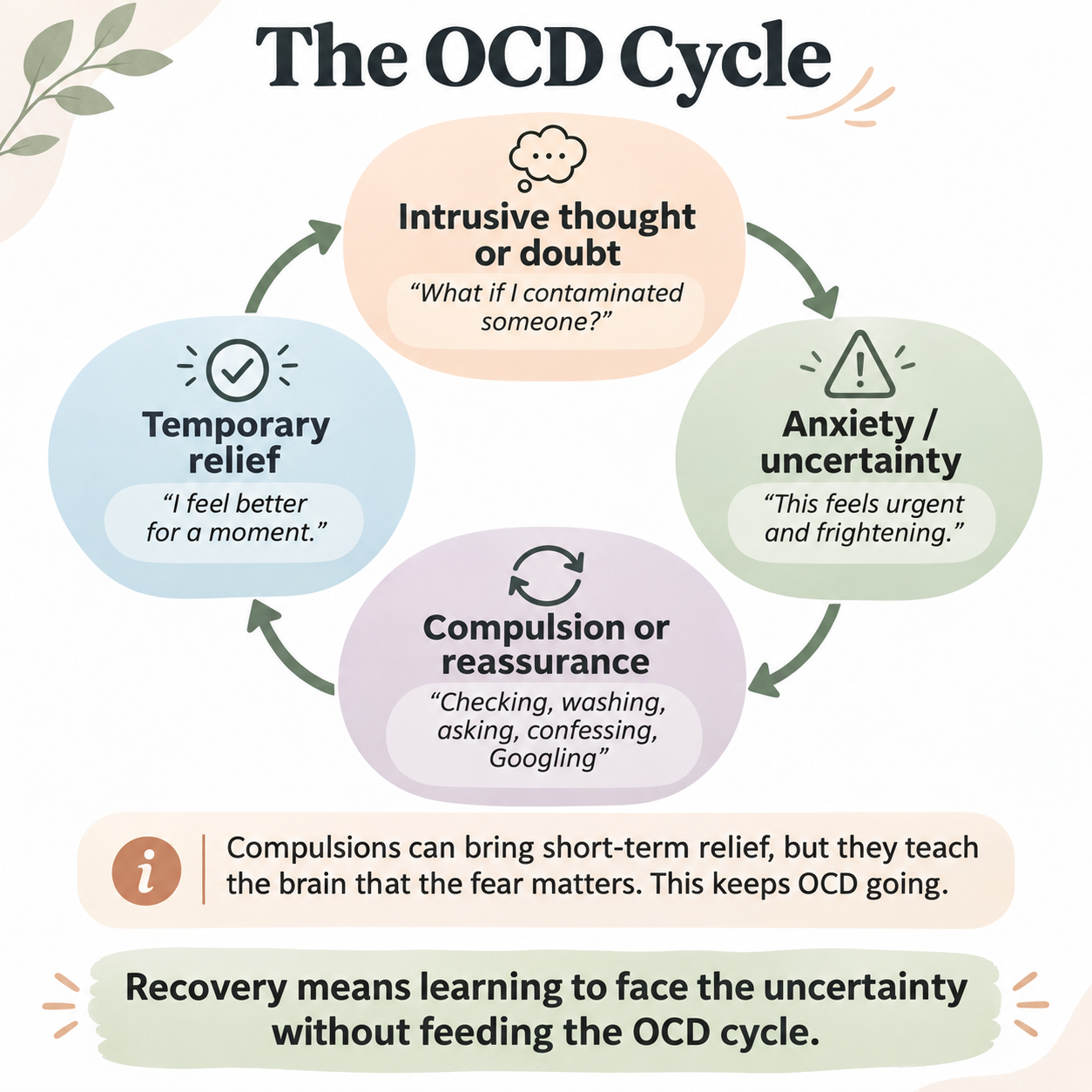
Why doesn't reassurance work?
When someone we love is frightened, we want to make it better. So we say, "Of course the door's locked," "Your hands are clean," or "You'd never do that."
But reassurance is a bit like a sticking plaster that falls off within minutes. Soon there's another question, then another. Families can also get pulled in by doing checks for them, changing routines, or avoiding certain topics to keep the peace. We call this "accommodation", and it's incredibly common. It comes from kindness, but it keeps the spotlight on the OCD.
NICE guidance on OCD recommends that therapists look at how much families are involved in compulsions and reassurance, and help everyone work on this together. So you really are part of the team.
What can I say instead?
How do we stay loving and supportive without feeding the OCD? The answer lies in supporting the person, not the OCD.
What might this look like in everyday life?
Imagine your partner asks you whether the front door is locked. You tell them it is. Five minutes later, they ask again. You reassure them, but the doubt soon returns.
It's natural to keep answering because you want them to feel better. But the more you provide certainty, the more OCD can learn to depend on it.
Instead, at a calm moment, you might agree together that next time you'll acknowledge how difficult the doubt feels, without repeatedly checking or answering.
You're not withdrawing your love or support. You're simply helping your loved one practise responding differently to OCD.
Here are some things you could say. Use them as a starting point and put them in your own words.
The most important one:
💛 "That sounds like OCD, and I want to help you, not your OCD."
When they ask for reassurance:
💛 "I can see how frightening this feels. I'm not going to answer the OCD, but I'm right here with you."
💛 "I love you too much to feed the OCD. Shall we do something together instead?"
When they want you to check or do something for them:
💛 "I know the urge feels really strong right now. I know this is uncomfortable. I'm here while you practise letting the uncertainty be there”
When they want to confess:
💛 "Thank you for trusting me. It sounds like OCD wants you to tell me everything. You don't need to give me the details. Nothing changes how I feel about you."
When doubts take over:
💛 "That sounds like OCD wanting certainty. None of us can be 100% sure. I know the uncertainty is uncomfortable. What might help you respond to it differently?"
When they're overwhelmed:
💛 "This is really hard, and you're doing so well. Feelings rise and fall like a wave. Let's ride it together."
💛 "Shall we move the spotlight? Tell me about your day / come for a walk with me / help me with this."
On tough days:
💛 "I can see OCD is loud today. Remember what you've learnt in therapy. I'm so proud of how hard you're working."
Do I have to stop reassuring them straight away?
You don't need to make sudden, sweeping changes. For many families, the most helpful approach is to agree a gradual, supportive plan together, ideally with guidance from an OCD therapist.
Suddenly saying "no" to everything can feel rejecting and frightening, a bit like "computer says no". That's not the aim.
Instead, talk together when things are calm, ideally with guidance from their therapist. Agree on the words you'll use, such as "That sounds like OCD", so it doesn't feel like a rejection when you say it. Step back gradually, together as a team in your united resistance to the OCD coming between you in your relationship.
You can also ask:
💛 "What would your therapist say right now?"
💛 "Is there something you've learnt in therapy that might help?"
💛 "What words help you most when you're struggling?"
Show an interest in their homework and offer to help. With their consent, you could even join part of a therapy session. With online therapy, this is easy to arrange at the end of an appointment.
What if your loved one doesn't want help?
It can be really difficult watching someone you love struggle with OCD, particularly when you can see how much it's affecting their life, but they don't feel ready to seek help.
You might find yourself wanting to explain what's happening, encourage them to see a therapist, or even challenge their OCD for them. All of this comes from a place of love, but pushing too hard can sometimes leave someone feeling misunderstood, defensive or even more anxious.
Start with curiosity, not persuasion. Choose a calm moment and gently share what you've noticed, without judgement. You might say:
💛 "I've noticed how exhausting things have been for you lately. How are you feeling about it?"
💛 "I can see how much this is affecting you, and I hate seeing you struggle. Have you ever thought about speaking to someone who understands OCD?"
💛 "You don't have to make any decisions right now. I just want you to know that there's help available whenever you're ready."
Try not to get drawn into arguments about whether their fears are rational or whether they really have OCD. Remember, the anxiety and uncertainty can feel incredibly real, even when the person recognises that their worries might not make sense.
And please don't try to become their therapist. It can be tempting to encourage them to face their fears or stop their compulsions, particularly once you understand how OCD works. But exposure exercises are best planned collaboratively with an appropriately trained therapist. Pushing someone into situations they aren't ready for can damage trust and leave them feeling overwhelmed.
Instead, focus on being alongside them. Listen, show an interest in how they're feeling, and gently encourage them to consider speaking with their GP or an OCD specialist. You could offer to help them explore their options or accompany them to an initial appointment if they'd find that reassuring.
Sometimes the first step isn't agreeing to therapy. It might simply be feeling understood, learning a little more about OCD, or recognising that things could be different.
You can open the door to getting help, but you can't make someone walk through it. What you can do is keep that door open, while looking after your own wellbeing and maintaining healthy boundaries.
And remember, you don't have to wait until your loved one is ready for therapy to seek guidance yourself. A therapist experienced in OCD can also help family members understand how best to respond and how to avoid becoming caught up in the OCD cycle.
Looking after you
Supporting someone with OCD can be tiring. Some of the things OCD says can be upsetting to hear. It can help to remember that a thought is not a wish, and a doubt is not a decision.
You're allowed to feel frustrated, worried or worn out. Find your own support, whether that's a friend, your GP or a therapist (My Therapist Online can help find you a therapist). Asking for help yourself can even be good for your loved one, as it reminds them they're not always the one who needs support.
If you're worried about their safety
Living with severe OCD can be exhausting, and some people become very low. If your loved one talks about harming themselves or feeling hopeless, please take it seriously. Encourage them to speak to their GP or therapist. In the UK, Samaritans are free to call, any time, on 116 123, and NHS 111 option 2 offers mental health support. In an emergency, call 999.
Celebrate the small wins
Recovery from OCD isn't a straight line. There will be brilliant days and really hard days. When your loved one resists a compulsion, sits with discomfort, or moves the spotlight back to the here and now, notice it.
💛 "I saw you didn't check just then. That took real courage."
💛 "You're doing it. I can see how much work you're putting in."
OCD makes people doubt themselves. Your encouragement helps them see their own strength.
Final thoughts
You don't need to be an expert. What helps most is being calm, kind and steady, and staying in your loved one's corner while they learn to be in their own.
With evidence-based treatment such as CBT with exposure and response prevention (ERP), and the right support at home, OCD is very treatable. I see people get better every day. They learn the skills to manage their minds, and they crack on with their lives.
If you'd like to speak to a specialist OCD therapist, get in touch with us by email or register your interest through our website.
How does therapy help someone with OCD?
Cognitive Behavioural Therapy (CBT), including Exposure and Response Prevention (ERP), is one of the main evidence-based treatments for OCD.
ERP helps people gradually face the situations, thoughts or uncertainties that trigger their OCD, while learning not to respond with their usual compulsions.
This isn't about forcing someone into frightening situations. A specialist therapist works collaboratively with them, helping them build confidence at a manageable pace.
Family and friends can play an important part in supporting this work, particularly when everyone understands how to respond to reassurance seeking and compulsions.
Finding the right support for OCD
If someone you love is struggling with OCD, you don't have to work everything out alone.
At My Therapist Online, we understand how important it is to find a therapist who really understands OCD.
Our clinician-led team takes the time to understand each person's individual difficulties and carefully matches them with an appropriately qualified therapist, including specialists in CBT and Exposure and Response Prevention (ERP).
All sessions take place online, making it easier to access specialist support wherever you are in the UK.
We also offer a free initial 15-minute conversation with your matched therapist, so you can see whether they feel right for you before committing to treatment.
And remember, if you're supporting someone with OCD, your wellbeing matters too. You deserve support just as much as they do.
Frequently asked questions about supporting someone with OCD
-
It's natural to want to reassure someone you love, particularly when they're frightened or distressed. However, if reassurance becomes part of an OCD compulsion, it can offer temporary relief while keeping the cycle going. Try to acknowledge how difficult things feel without repeatedly answering the OCD's demands for certainty.
-
Try to avoid comments such as "Just stop thinking about it", "You're being irrational", or "There's nothing to worry about". These can leave someone feeling misunderstood or ashamed. Instead, acknowledge their distress and support them in using strategies they've agreed with their therapist.
-
Start by listening without judgement. You might gently explain what you've noticed and ask whether they would be open to finding out more about OCD. Avoid pressuring them or attempting exposure exercises yourself. Encourage them to speak to their GP or an appropriately qualified therapist when they're ready.
-
Absolutely. OCD can affect everyday routines, communication, intimacy and family activities. Loved ones may find themselves repeatedly providing reassurance, participating in rituals or changing their behaviour to avoid triggering distress. Understanding these patterns and working together can help protect both the relationship and the person's recovery.
-
Cognitive Behavioural Therapy (CBT) that includes Exposure and Response Prevention (ERP) is a recommended treatment for OCD. ERP helps people gradually learn to face their fears and uncertainties without relying on compulsions to feel safe. A specialist therapist can develop an approach suited to the individual's needs.
About the Author & Clinical Reviewer

Lisa Johnston, BSc, BSc (Hons), BABCP Accredited
Co-Founder & Clinical Director, My Therapist Online
Lisa Johnston is a BABCP-accredited Cognitive Behavioural Therapist and EMDR therapist with over 23 years of experience in mental health. She previously spent seven years working within the specialist Anxiety Disorders Residential Unit at Bethlem Royal Hospital, developing expertise in OCD, Body Dysmorphic Disorder and emetophobia.
Lisa co-founded My Therapist Online with her husband Keith in 2016 and continues to lead the clinical direction of the service. She is passionate about helping people access appropriate, evidence-based psychological therapy through thoughtful, personalised therapist matching.
Read Lisa Johnston's full professional profile
Clinically reviewed by: Lisa Johnston, BABCP Accredited CBT Therapist & EMDR Therapist
Last updated: 23rd November 2026